|
|
"The heavens declare the glory of God" Psalm 19:1"
|
City:
TUCSON
|
Latitude:
32 00N
|
Latitude:
111 00W
|
Julian Date
2455623.708
|
|
Solar
|
Sunrise
|
6:49 AM
|
|
Sunset
|
6:23 PM
|
|
Distance
|
92,192,503 Miles
|
|
Angular Size
|
32.26 Min. of Arc
|
|
Position
|
22hr 38min -6° 57'
|
|
Constellation
|
Aquarius
|
|
Lunar
|
Moonrise
|
5:56 AM
|
|
Moonset
|
5:39 PM
|
|
Distance
|
247,671 Miles
|
|
Angular Size
|
30 Min. of Arc
|
|
Position
|
21hr 02min -9° 38'
|
|
Constellation
|
Capricornus
|
|
Phase
|
3.45%
|
|
Lunar Phases
| New Moon | 3/4/2011 | 20 46 UT |
| 1st Quarter | 3/12/2011 | 23 45 UT |
| Full Moon | 3/19/2011 | 18 10 UT |
| 3rd Moon | 3/26/2011 | 12 07 UT |
| New Moon | 4/3/2011 | 14 32 UT |
| 1st Quarter | 4/11/2011 | 12 05 UT |
| Full Moon | 4/18/2011 | 2 44 UT |
|
Planets
|
Planet
|
Rises
|
Transits
|
Sets
|
Constellation
|
Distance from Earth
|
Distance from Sun
|
|
Mercury
|
7:07 AM
|
12:55 PM
|
6:39 PM
|
Aquarius
|
32,554,553 Miles
|
123,008,016 Miles
|
|
Venus
|
4:40 AM
|
9:54 AM
|
3:03 PM
|
Capricornus
|
99,248,685 Miles
|
67,386,872 Miles
|
|
Mars
|
6:36 AM
|
12:15 PM
|
|
Aquarius
|
128,498,867 Miles
|
219,882,313 Miles
|
|
Jupiter
|
8:03 AM
|
2:13 PM
|
8:18 PM
|
Pices
|
460,387,104 Miles
|
541,366,927 Miles
|
|
Saturn
|
8:47 PM
|
2:42 AM
|
8:36 AM
|
Virgo
|
894,119,205 Miles
|
816,380,998 Miles
|
|
Uranus
|
7:39 AM
|
1:41 PM
|
7:38 PM
|
Pices
|
1,869,212,224 Miles
|
1,956,512,719 Miles
|
|
Neptune
|
6:13 AM
|
11:46 AM
|
5:14 PM
|
Aquarius
|
2,795,839,455 Miles
|
2,885,316,760 Miles
|
|
Pluto
|
2:52 AM
|
8:08 AM
|
1:20 PM
|
Sagittarius
|
3,015,179,927 Miles
|
3,057,887,982 Miles
|
|
|
|
|
|
|
1,375,986
Web site visits since 1997 and
93,364
mobile visits since 2005
|
|
|
CCD Explorer Windows Software
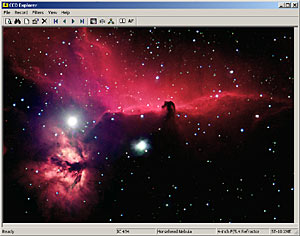
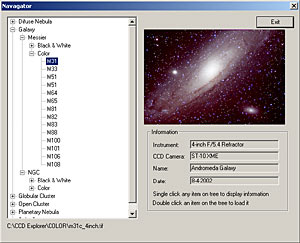
A free Windows based program I wrote that allows you to store information about your CCD images in a database. The program allows you to organize and sort your images. This will be especially interesting for undergrads looking for Java homework help or any simply interested in both programming and astronomy. It supports most graphic formats and has many features built into it including support for 16 and 32 bit images. Although created for CCD imaging, it can be used for astrophotography as well.
CCD Explore has many new features that were not in version 1.0 such as printing, some image processing, and converting to other file formats. In addition you can now customize your reference tables for equipment, cameras, and filters you use.
The software comes with an installer and will work with Windows 98 or higher including Windows Vista, the next version of Windows
Useful software can also include custompapers review, which will help you choose the best writer for your academic work
In addition, the software has some 45,000 defined U.S. cities with longitude, latitude, time zones, and other information. Using defined cities, you can quickly look up information on the sun, moon, and planets. For more information on the subject needed to write academic project, benefit from AssignCode.com programming homework help.
CCD Explorer is FREE
Coming later this summer:
CCD Explorer 3.0 and Sharpless Catalog for Windows

|
|
This Web site is owned and managed by Dean Salman. I have been into astronomy since the late 1960’s and doing photography with film from 1973 to 2001. In 2001, I switched to CCD imaging and have been doing that since then. I am asking that you respect my wishes and do not sell any of my images or claim them as your own work.
My images I post on the site are considered freeware and can be used for your own personal use, which includes school projects, a book or article you are publishing, or just printing the image for your own use. If you do use then in printed material such as a book, just credit me or my web site as a reference, nothing else.
My Web site is designed so that you can customize it on your computer for your location to get statistical information on the sun, moon, and planets. This includes lunar phases to 2035, rise and set times, magnitudes, phases, RA and DEC positions, distances, and much more. In addition, I update my database every month with current events happening in the sky and what the planets are doing for the current month. To set up your location, just enter your US or Canada city or zip code on the top of the page. If your city is not found or you do not have a U.S. or Canada zip code, use the City Locator. You can save your location for future visits so you do not have to enter your information each time you visit my site. Be sure to check out my mobile web site as well if you have access to the Web on your cell phone.
Exploring the Wonders of Science through Assignmaths.com
|
Other Web Sites
San Pedro Valley Observatory
The well-known Astronomers Inn (formerly The Skywatchers Inn) on the east side of Benson has reopened as the San Pedro Valley
Observatory (SPVO). It is the site of the old Vega-Bray Observatory containing the wonderful 20-inch Maksutov, one of the
largest telescopes of its kind in the US. Eventually plans to have remotely controlled telescopes for those who want to
observe from their homes. For those on vacation, telescopes and host astronomers available for hire to give sky tours.
Galaxy Map
Have you ever wondered what our Milky Way galaxy would look like from outside, as viewed from an interstellar space ship? This website presents a face-on map of much of the Milky Way, including the distances and positions of more than 8 thousand bright stars, star clusters, nebulae and giant molecular clouds. Unlike rough diagrams based on speculation, the location of each object on the galaxy map is based on the scientific literature. This may be the most accurate and detailed Milky Way map ever created
Astronomy Online Readers Gallery
Welcome to Astronomy magazine's Online Reader Gallery — a collection of spectacular images from astrophotographers around the world. Categories include Galaxies, Nebulae, Star Clusters, Planets, Sun and Moon, Comets, and Other
CCD Commander
Imagine setting up for a night of imaging, falling asleep, and then waking in the morning with images of multiple targets - each autoguided and autofocused. Your mount is parked and you have darks and flats for all your images. With a quick glance you confirm that all your images were guided successfully and your camera temperature was stable throughout the night. All of this is a reality with CCD Commander.
Instructional DVD Video By Adam Block
Learn the foundation for creating spectacular astronomical images in Photoshop! This video is the first in a series of tutorials that will lead the novice imager on a informative journey through the tips and techniques of manipulating CCD images.
CCD Stack by CCDWare
CCDWare is a software company that has the tools you need when it comes to CCD Imaging.
Star Parties
A complete listing of North American Star Parties organized by month.
Space Weather
For the latest solar forecast and aurora updates, visit SpaceWeather.com
Telescope Rental from Cherry Mountain Observatory
Cherry Mountain Observatory is a fully automated, robotic observatory located outside of Fredericksburg, Texas. The observatory is focused on advanced astro-imaging and
visual exploration using leading edge technologies and approaches.
|
Friends
Andrew Cooper
Darrell Crofford
Keith Schlottman
Mike Sherick
James McGaha
Randy Davidson
Richard Payne
Rockett Crawford
Rusty Fletcher
|
|